


What Does Turnkey Mean? Definition, Scope and Process
Turnkey means entrusting a project, from design to finished handover, to a single firm under a single contract. What it covers, how it differs from managing the work piece by piece, and what to watch for — we make it clear.
Turnkey is a way of working in which the entire process — from a project's design to material selection, from its construction to the last detail — is handed to a single firm under a single contract, and a finished building is delivered to you, made ready for you to simply “turn the key and move in.” The client proceeds with a single point of contact; coordination, procurement and responsibility rest with the contractor. The term comes literally from “handing over the key”: a space ready to be lived in or operated. In this article we explain step by step exactly what turnkey covers, how it differs from managing the work piece by piece, its advantages, and what to watch for in the contract.
Turnkey means that the entire design, permitting, construction, implementation and finishing work of a building is handed to a single contractor under a single contract, and that a ready-to-use, finished product is delivered at the end of the job. Throughout the process the client does not negotiate separately with an architect, a builder, suppliers and tradespeople one by one; a single firm takes on all coordination. At the moment of handover, when you enter the building you find a fully functioning space — which is where the name comes from: take the key and walk in.
Although the scope may vary by contract, a well-structured turnkey model generally includes the following items:
- Architectural and interior design, concept and implementation projects
- Structural, mechanical and electrical projects together with engineering calculations
- Follow-up of permits, approvals and official procedures
- Shell construction: foundation, load-bearing system, envelope and insulation
- Fine works: plaster, screed, cladding, paint, joinery, façade
- Mechanical and electrical installations, smart home and automation infrastructure
- Material procurement, kitchen, bathroom and fixed furniture application
- Landscaping, pool and outdoor works (if within scope)
- Cleaning, testing, commissioning and finished handover
In the classic method the client obtains the design from one office, the construction from a builder, the materials from separate suppliers, and has to coordinate all these parties personally. When one item is delayed or a gap in responsibility arises, the argument over “whose fault it is” falls on the client's shoulders. In turnkey, on the other hand, the entire chain from design to handover is gathered in one hand: one contract, one budget, one schedule, one responsible party. The risk of coordination between the parties passes from the client to the contractor.
The essence of turnkey is hidden in a single sentence: do not divide responsibility. One point of contact, one signature, one finished result.
The core advantages this model offers the client can be grouped under three headings. First, a single point of contact: for every question, every decision and every problem there is a single address, and the parties do not pass the work between one another. Second, budget and time control: because the job is bound from the start by a single contract and a clear schedule, surprises are minimized and payments are tied to progress. Third, clear responsibility: when a defect appears the responsible party is known, and the warranty and handover criteria are managed from a single hand. To this are added time savings and a lightening of the mental burden — the client is not the manager of the process but its owner.
A well-managed turnkey project generally follows these steps:
- 1Discovery and needs analysis: clarifying the plot, budget, living or operating program and expectations.
- 2Concept and design: creating the architectural-interior concept, the material language and the preliminary budget.
- 3Contract and planning: binding the scope, schedule, progress payments and handover criteria into a single contract.
- 4Implementation projects and permits: completing all engineering projects and obtaining the approvals.
- 5Construction and implementation: running the entire site, from shell to fine works, from procurement to installation.
- 6Testing, commissioning and handover: the checklist, the snag-free inspection and the turnkey handover of the finished building.
In luxury villas, turnkey is especially valuable because it preserves the integrity of the design: when the team that draws the concept and the team that builds it are the same, the space on paper comes to life exactly. In hotel and boutique accommodation projects, turnkey is taken one step further — an operational turnkey handover: alongside architecture and construction, the interior scheme, furniture and decoration (FF&E) and operating infrastructure are also included, so the building is handed over ready to welcome its first guest. In both cases the client relies on a single vision and a single responsible party.
The model is powerful, but its strength comes from the clarity of the contract. Before signing, be sure to clarify the following points: the boundaries of the scope (what is included and what is excluded must be written item by item); the payment plan and progress-payment basis (payments must be tied to completed portions of work, with no front-loaded lump sums); the schedule and delay conditions; the brand and quality level of the materials to be used; the change (revision) procedure and management of price differences; and, most importantly, the handover criteria and warranty — under what conditions the building will be deemed “finished” and the scope of the post-handover warranty must be clearly defined. A transparent contractor does not shy away from writing these items into the contract.
At Vesya we deliver luxury villa and hotel projects on a turnkey basis, from design to finished handover: a single vision, a single contract, a single responsible team. The fact that the team that draws the concept and the team that builds it are the same guarantees that the space on paper comes to life exactly; you remain the owner without having to manage the process. To discuss your project and clarify its scope and budget, we invite you to a non-binding preliminary meeting — let us listen to your plot and your expectations, and map out the right road together.
In short
- Turnkey means entrusting the entire job — from design to finished handover — to a single firm under one contract.
- Its core advantages: a single point of contact, budget and time control, and clear, undivided responsibility.
- In hotels the model goes one step further: including FF&E and operating infrastructure, handed over ready for guests.
- Its strength comes from the clarity of the contract: write the scope, progress payments and handover criteria item by item.
How we can help you on this
Journal
 Villa
VillaTurnkey Villa: One Team From Design to Handover
One contract, one responsibility — from land to keys. We explain step by step how a turnkey villa works, what determines its cost and what to watch for in the contract.
July 20269 min read Process
Villa Project Consultancy: What It Is, What It Covers, When You Need It
What is villa project consultancy, what does it cover and when do you need it? We explain, through an expert's eye, the difference made by single-point management — from feasibility to site supervision — and how the cost becomes clear.
July 20267 min read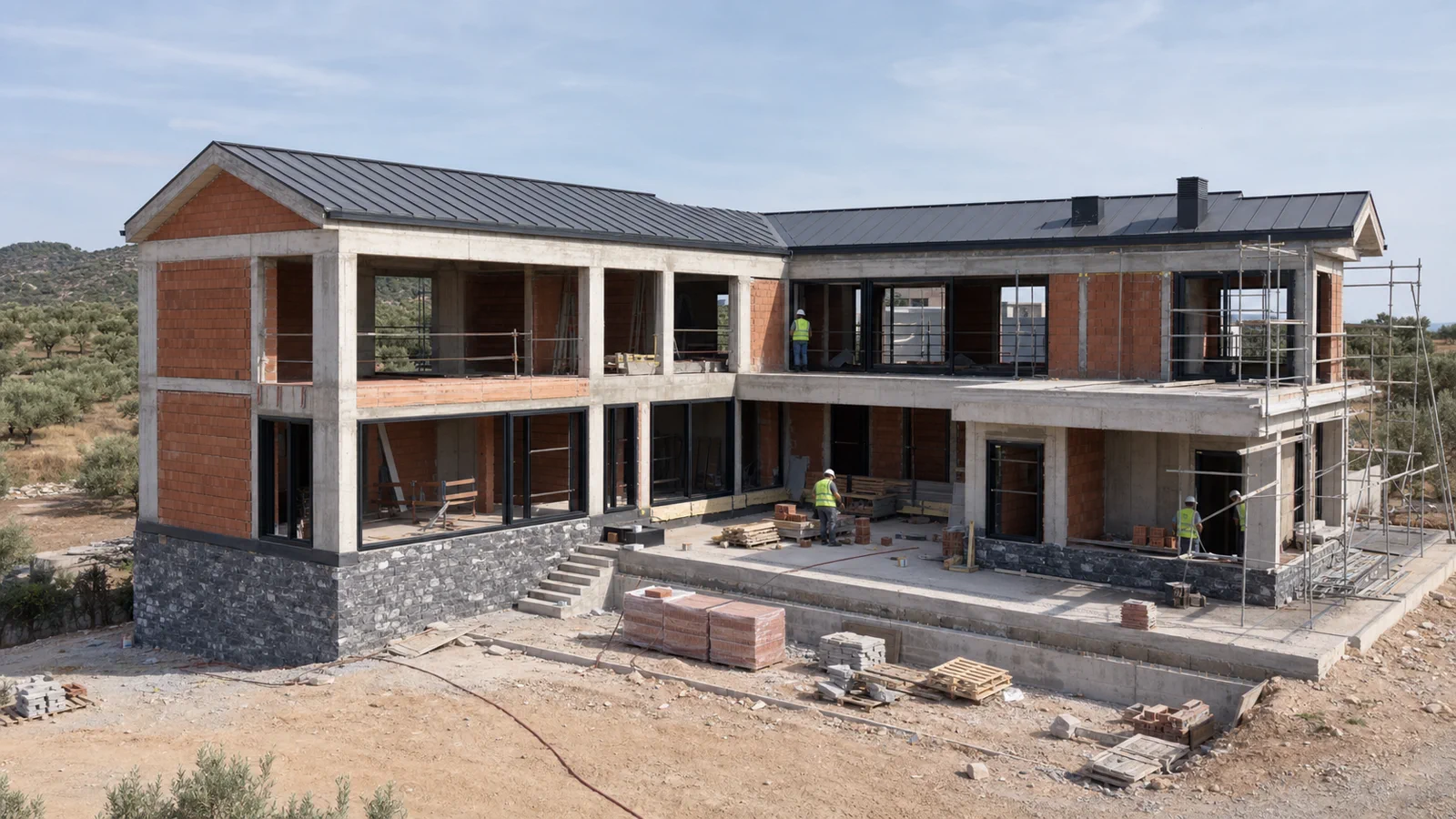 Villa
VillaVilla Construction Cost 2026: The Factors That Set the Price
There is no single answer to "how much does a villa cost?"; the cost is the sum of the decisions you make. We explain what determines the m² price, which line items get overlooked, and how to read a transparent quote.
July 20268 min readFrequently asked questions
Vesya Project Team
Design · Build · Construction
- Response time
- Same day
- Channels
- Phone · Email · WhatsApp
Can't find your answer here? Send us your question directly — our team will reply shortly.
Free consultationTurnkey means that the entire design, project, permitting, construction and finishing work of a building is handed to a single firm under a single contract, and that a ready-to-use, finished building is delivered at the end of the job. The client proceeds with a single point of contact; coordination and responsibility rest with the contractor. The name comes from being able to take the key and walk straight in.
Vesya Project Team
A well-structured turnkey price generally covers the design and engineering projects, the permitting process, the shell and fine construction works, the mechanical-electrical installations, the material procurement and the finished handover. Whether items such as landscaping, a pool or furniture are included varies by contract; this is why it is important that the scope is written item by item.
Vesya Project Team
Its greatest advantage is that responsibility is not divided. Because the entire chain from design to handover is with a single firm, the client proceeds with a single point of contact and does not bear the risk of coordination between the parties. This brings with it more controlled management of budget and time and, in the event of a defect, a clear single-address warranty process.
Vesya Project Team
The duration varies according to the size of the building, the plot conditions, the permitting process and the material choices. For a mid-sized luxury villa, the typical time from design to handover is mostly in the range of 16–22 months; in hotel projects this may lengthen because the scope is broader. A precise schedule can only be written into the contract once the concept and scope are clear.
Vesya Project Team