
Luxury Villa Interior Design: Material, Texture, Light and the Grammar of Quiet Luxury
What makes a villa "good" rather than merely "expensive" is honesty of material, consistency of texture and the staging of light. We spell out the grammar of quiet luxury, line by line.
Luxury villa interior design comes down to getting three things right: honest material, consistent texture and layered light. A space that tries to look expensive usually feels cheap; real luxury is quiet, reveals itself to the touch and shifts with the light throughout the day. Below we unpack these three axes one by one, showing how each turns into a concrete decision in a Turkish villa project.
There is a scene that keeps repeating in villa projects. The client arrives with dozens of images saved over months; each is beautiful on its own, but spread across the table the space looks tired. The reason is almost always the same: the pieces are individually luxurious, the whole is scattered. This is exactly where the real work of luxury villa interior design begins — not collecting beautiful things, but building a language between them.
That language has three letters. Material tells you what the space is built from; texture, how it feels; light, how it looks at each hour of the day. When these three speak to one another, you place the furniture, the rug and the artwork afterwards with almost no effort. When they do not, even the most expensive sofa will not pull the room together.
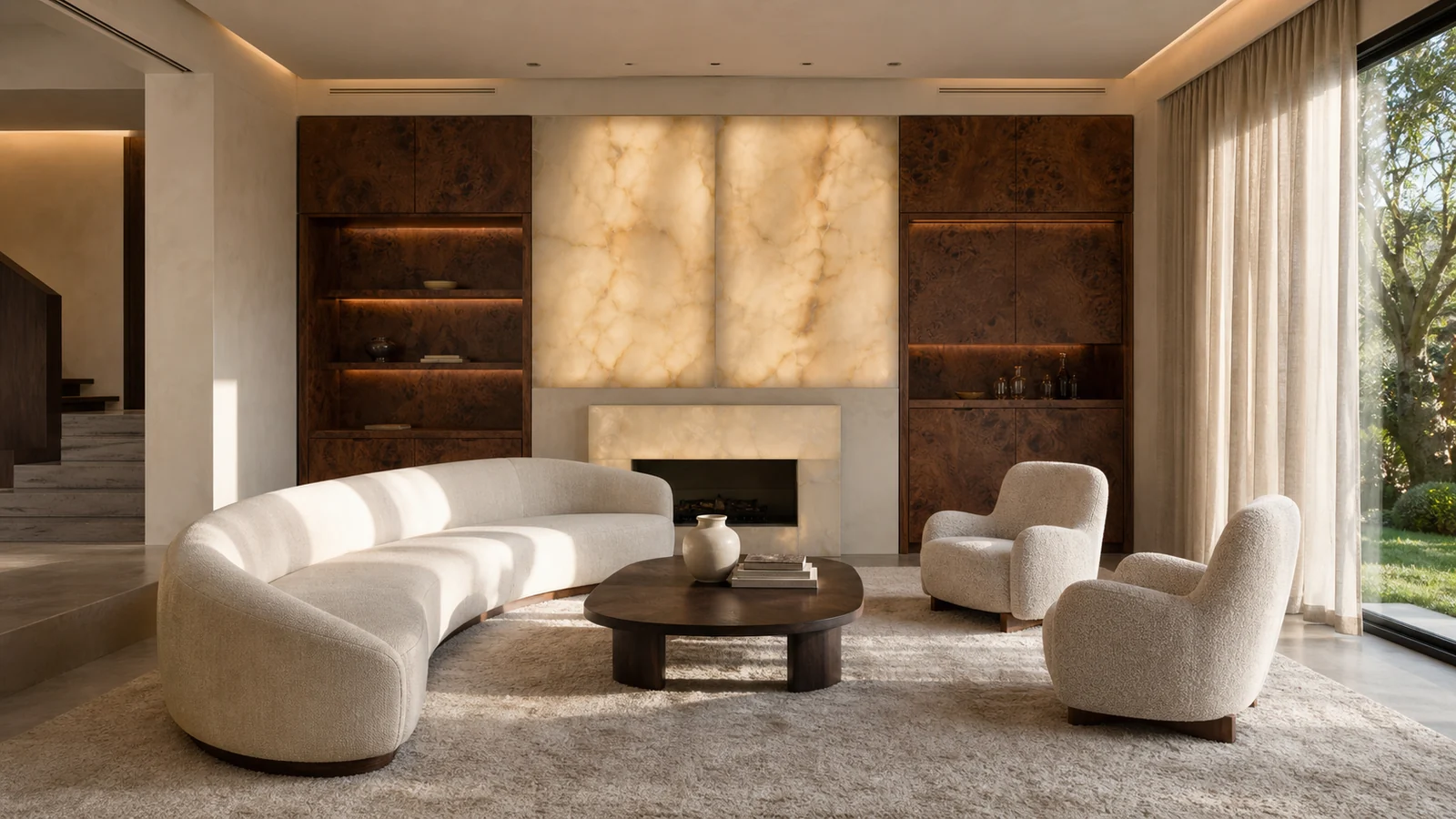
Quiet luxury is luxury that does not announce itself. There is no logo on the wall, no gold leaf, not every surface gleams. Instead there is a quality you notice by touch: the matte of the plaster, the real grain of the wood, the coolness of the stone, the weight of the linen. The eye may not be struck at first glance; but anyone who spends ten minutes in that space understands the difference with their body.
Showy luxury does the opposite. It impresses in the first second and tires you when lived in again and again, because every surface demands attention and none lets you rest. Yet a villa is not a hotel suite. It is a place to be lived in for years, where breakfast is eaten and a child grows up. That is why the right reference for a villa is the space that still looks beautiful at the hundredth glance, not the first.
A good villa interior proves itself not in a photograph, but when you spend a Saturday morning inside it.
The first rule of luxury is not to multiply but to limit. Keeping the number of primary materials in a villa interior to around four or five is almost always more elegant than adding variety. Richness comes not from the count of materials, but from the quality of those few chosen materials and their consistent repetition.
- Natural stone — Travertine, marble or basalt; on floors and in wet areas it builds the backbone of the space. A matte finish usually reads as more sophisticated than a glossy one.
- Solid wood — Oak, walnut or ash; wherever possible choose solid over veneer, because luxury is understood when touched.
- Plaster and mineral surfaces — Matte, off-white and sand tones that soften the light; the quiet, unassuming ground of a villa.
- Natural textiles — Linen, wool, raw cotton; surfaces that breathe and absorb light instead of the plastic sheen of synthetics.
- Metal accent — Brushed brass or matte bronze; used sparingly, it does not glitter like gold and grows more beautiful as it takes on a patina over time.
The secret to how this palette works is one word: repetition. If the oak you see in the living room reappears under the kitchen counter and at the head of the bed, the villa feels as though it came from a single mind. Setting up a separate theme for each room is amateur work; however expensive, it reads as scattered.
People stare at color swatches for hours, yet what truly makes a space is texture. Two rooms may be painted the same beige: one in matte mineral plaster, the other in plastic-based paint. In a photograph there is no difference; in reality there is a gulf between them. This is the most invisible yet most decisive layer of luxury villa interior design.
The right composition balances textures in contrast. A roughly woven linen curtain beside a smooth marble counter; a wood console with pronounced grain in front of a matte plastered wall. If everything is smooth the space turns sterile; if everything is rough it tires. Mastery is finding a rhythm between these two extremes.
- Hard–soft balance — Pair hard surfaces like stone and glass with soft textures such as wool rugs and linen curtains.
- Matte-dominant rule — Let the majority of surfaces be matte; shine is measured, used only for accent.
- Layered depth — A second weave over the rug, cushions in a different fabric on the sofa; a single layer reads flat, many layers read rich.
- Ageing material — Brass that takes a patina, oxidising copper, wood cared for with natural oil; choose surfaces that grow more beautiful with time rather than wear out.
Light is the most underestimated subject in villa interior design, yet it determines the outcome most of all. A well-chosen material dies in bad light; an ordinary material gains character in the right light. Leaving lighting to a single ceiling fixture is the most common mistake, and the one that costs the most.
In a professional composition, light is thought of in three layers. General lighting is the base that fills the space; task lighting solves functional points like a counter, a reading corner or a mirror; accent lighting brings a painting, a stone texture or a niche forward. When these three layers can each be dimmed separately, the same living room feels right at morning breakfast and during a night-time film alike.
- 1Start with natural light: write into the plan the orientation of the windows, the sun's movement through the day, and which room gets morning and which evening light; artificial light is built on top of this.
- 2Separate the layers: connect general, task and accent lighting to different circuits so each scenario can be managed independently.
- 3Fix the color temperature: stay in the warm white band (2700–3000K) throughout the villa; a color temperature that changes room to room cheapens the space.
- 4Hide the light: see the effect, not the source; concealed lines in niches, near the ceiling and under furniture give the space volume and an expensive softness.
- 5Dimming is essential: put a dimmer on every main circuit; a villa where you cannot adjust the strength of the light cannot adjust its atmosphere either.
Material is the body of a space, texture its skin, and light its mood. If you cannot adjust the light, you cannot adjust the mood of the space either.
There is one more layer that does not make it into a photograph but truly makes a villa luxurious. The echo of a footstep in a high-ceilinged stone hall, the rug that absorbs that echo, the faint warm scent wood adds to a room, the sound a curtain makes in the breeze. None of these is an accident; each is a design decision. A villa whose acoustics have not been considered looks magnificent but stays cold when lived in.
Then there is the share of emptiness. The most expensive material of quiet luxury is often emptiness itself: a deliberately bare wall, an unfilled corner, a hall that breathes. Resisting the urge to fill every square meter with furniture lifts most villas into a higher league. A single, well-placed piece always reads as more valuable than a crowded, cramped arrangement.
When it comes to numbers, one has to be honest. The per-square-meter prices circulating online are often misleading, because the cost of luxury villa interior design varies enormously with the quarry of the chosen stone, whether the wood is solid or veneer, the brand of the lighting and the quality of the workmanship. The same 300-square-meter villa can produce two figures far apart depending on the material choices.
That is why, in any serious project, the only correct method is the room-by-room specification list: a list written surface by surface, room by room, stating exactly which material goes where. A firm quote is built only on top of this. The party who first draws up the specification list, rather than one who quotes a per-square-meter price up front, protects you; because surprises always come from items not written on the list.
Vesya's way of working sits exactly here. Because we run design, application and construction from a single hand, the disconnect between the stonemason and the lighting specialist, between the carpenter and the site team, is eliminated from the start. The client talks not to six separate firms but to a single contact; decisions are not lost along the way, responsibility is not divided. We manage the budget with the same transparency: the range is discussed from the very beginning, the quote is made clear item by item with the specification list, and no surprise item appears later.
- Too many materials — Five kinds of stone, three types of wood; what is taken for richness is actually indecision, and it tires the space.
- A single ceiling light — Unlayered lighting makes even the best material look flat and cheap.
- Chasing trends — A villa locked to this year's color looks dated three years on; natural material, by contrast, is timeless.
- Forgetting acoustics — A magnificent but echoing space wins in a photograph and loses in life.
- Fearing emptiness — Filling every corner grows not luxury but congestion.
In short
- Luxury villa interior design is built on the consistent repetition of a few honest materials throughout the villa; quality, not variety, reads as rich.
- Texture does not show in a photograph, but it is texture that truly defines a space: the hard-soft balance and matte-dominant surfaces are the foundation of quiet luxury.
- Light should be composed in three layers (general, task, accent), every circuit dimmable, and the color temperature kept constant throughout the villa.
- The real price emerges from the specification list, not the square meter; a transparent, single-source process prevents surprise costs.
How we can help you on this
Journal
 Interior
What Does an Interior Designer Do? When Do They Step Into a Project?
An interior designer shapes both how a space works and how it feels. We explain what they do, how they differ from an architect, and exactly when they should step into a villa or hotel project — through an expert lens.
July 20268 min read Interior
Interior Designer vs Architect: Which One for Your Villa, and When?
In a villa, the architect handles the skeleton and permits while the interior designer creates a livable interior. Here is who to hire and when, told through concrete scenarios.
July 20267 min read Interior
How to Choose an Interior Design Firm: 7 Critical Points to Watch
When choosing an interior design firm, we explain—through an expert's eyes—the 7 critical points to check, from portfolio to contract and from references to single-point responsibility, along with the questions to ask in your first meeting.
July 20268 min read Interior
American Kitchen (Open-Plan Kitchen): Flawless Design in a Luxury Villa
The American kitchen is an open-plan layout that merges the cooking area with the living space. We explain its advantages, its disadvantages and how it is executed flawlessly in a luxury villa.
July 20267 min read Interior
What Does Anthracite Mean? Definition, Shades and Use of the Color
Anthracite is a deep color tone between dark gray and smoke. It takes its name from anthracite coal. We cover its definition, shades, complementary colors and balanced use in interiors.
July 20266 min read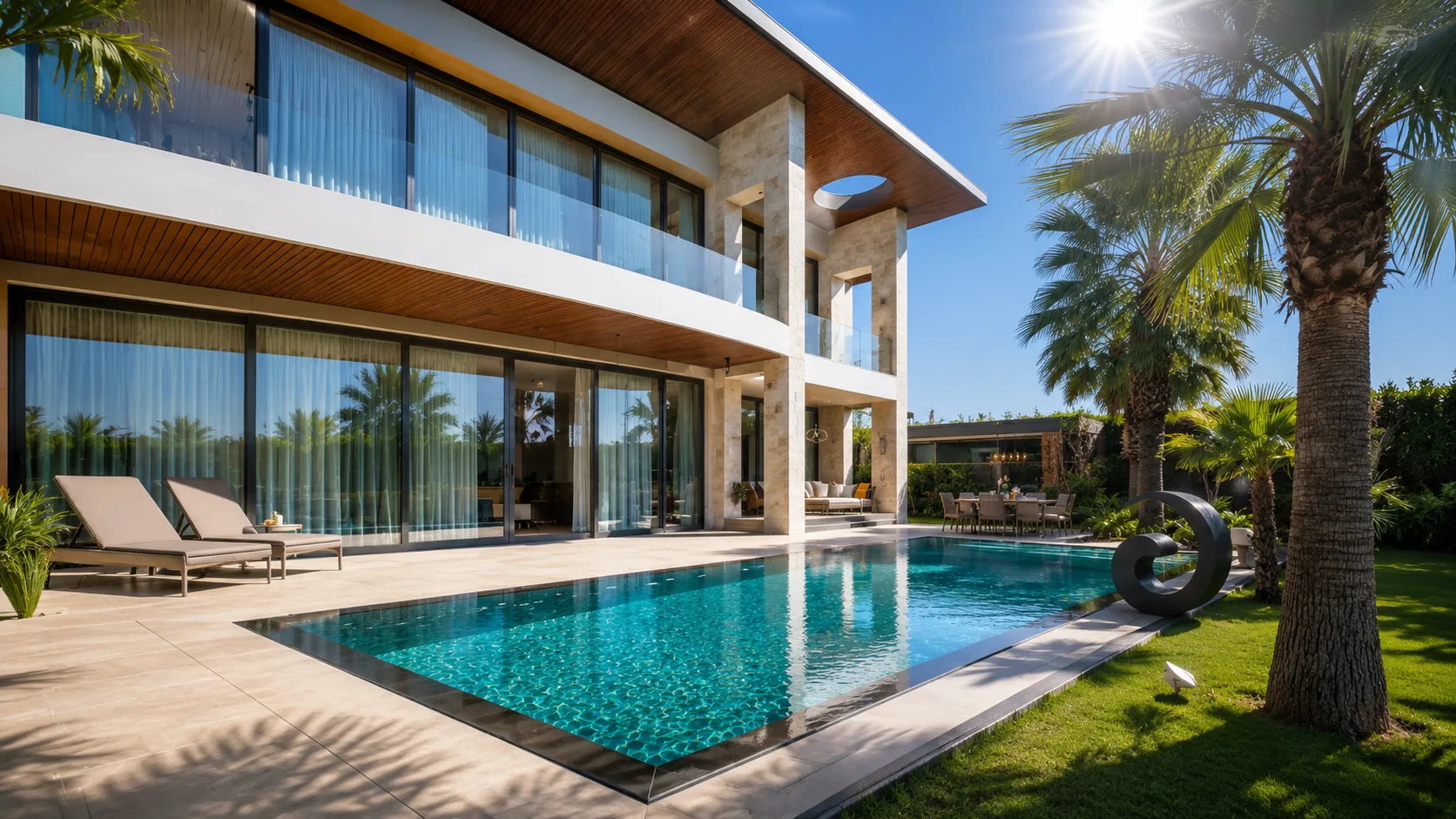 Trends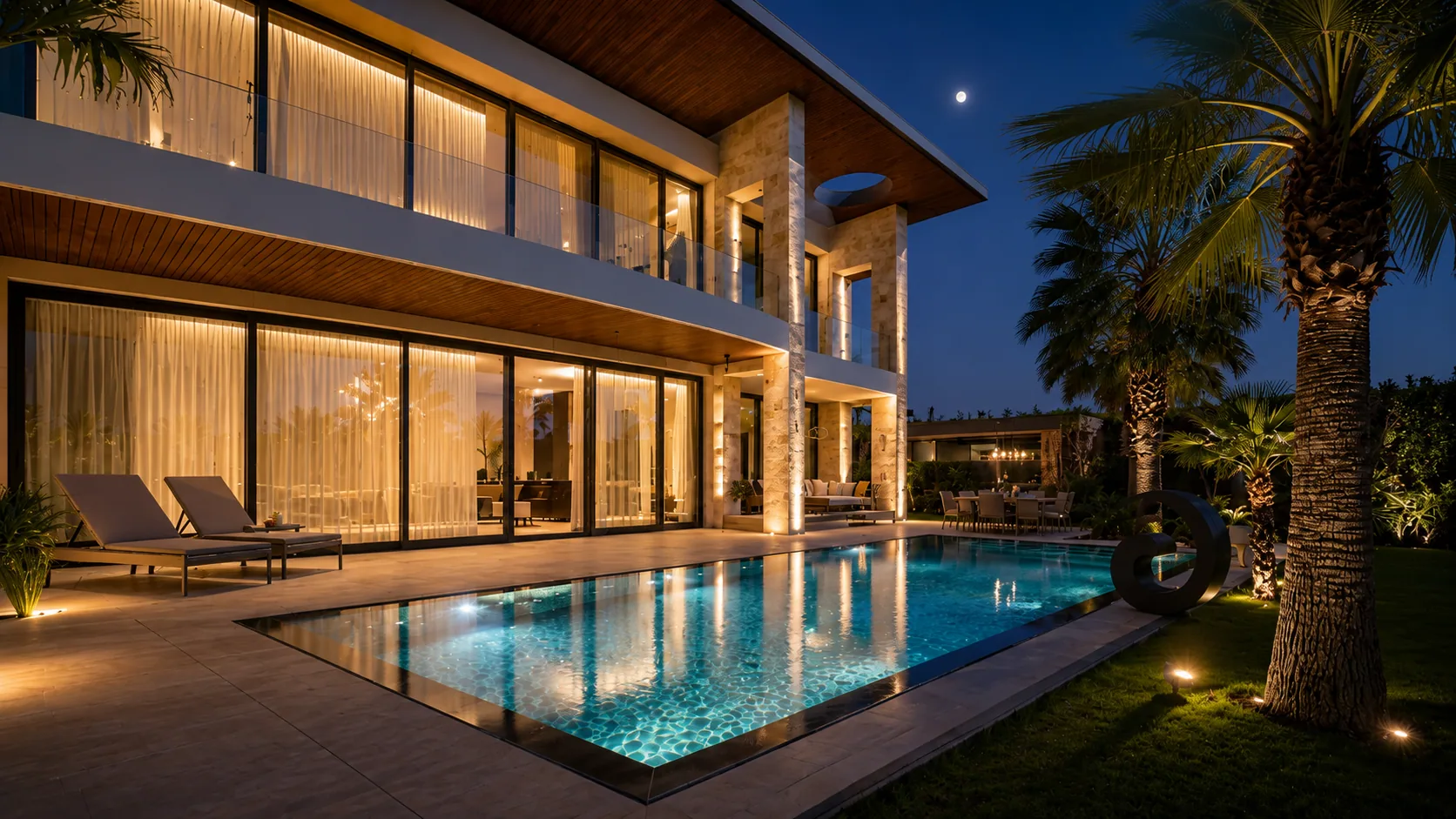
What Is Art Deco? The Language of Geometric Elegance and Luxury
Art Deco translates the radiant optimism of the 1920s–30s into geometry, symmetry and rich materials. We examine its origins, characteristic elements and interpretation in today's luxury interiors.
July 20267 min readFrequently asked questions
Vesya Project Team
Design · Build · Construction
- Response time
- Same day
- Channels
- Phone · Email · WhatsApp
Can't find your answer here? Send us your question directly — our team will reply shortly.
Free consultationLuxury villa interior design generally favours a few but high-quality natural materials: natural stone (travertine, marble, basalt), solid wood (oak, walnut, ash), matte mineral plaster, natural textiles such as linen and wool, and measured metal accents like brushed brass. The key is not to multiply materials but to repeat four or five of them consistently throughout the villa. Richness comes not from variety, but from the quality and consistency of the chosen material.
Vesya Project Team
Quiet luxury is a design approach that expresses itself through quality rather than show. Instead of gold leaf, glossy surfaces and eye-catching details, it foregrounds a quality noticed by touch: matte plaster, real wood grain, the coolness of natural stone, the weight of linen. It reveals itself not at first glance but as you spend time in the space. It suits villas especially well, because a space that will be lived in for years should look beautiful at the hundredth glance, not the first second.
Vesya Project Team
Good villa lighting is composed in three layers: general lighting that fills the space, task lighting that solves points like a counter and a reading corner, and accent lighting that brings a painting or a stone texture forward. These layers should be connected to separate circuits, each dimmable. The color temperature should be kept constant in the warm white band (2700–3000K) throughout the villa, and the light source concealed so that only its effect is visible. This way the same living room feels right at morning breakfast and during a night-time film alike.
Vesya Project Team
Giving a single per-square-meter price would be misleading, because the cost varies enormously with the type of stone chosen, whether the wood is solid or veneer, the quality of the lighting and the workmanship. The same villa can produce two very different figures depending on the material choices. The correct method is the specification list: room by room, surface by surface, which material goes where is written out one by one, and a firm quote is built on top of it. The party who first draws up a specification list, rather than one who quotes a per-square-meter price up front, protects you from surprise costs.
Vesya Project Team
Textures are balanced in contrast. Hard and soft surfaces are paired — a rough linen curtain beside a smooth marble counter, a grainy wood console in front of a matte plastered wall. The majority of surfaces should be matte, with shine used sparingly only for accent. Layered depth matters too: a second weave over the rug and cushions in a different fabric on the sofa enrich the space. Everything smooth yields a sterile result, everything rough a tiring one; mastery is establishing a rhythm between the two.
Vesya Project Team
The greatest losses in villa interior design arise from the disconnect between designer, carpenter, lighting specialist and site team. When design, application and construction are run from a single hand, decisions pass from one side to another without being lost, responsibility is not divided, and the client talks to a single contact rather than six separate firms. This protects both the quality of the work and budget transparency: the range is discussed from the very beginning, the quote is made clear with the specification list, and no surprise item appears later.
Vesya Project Team