
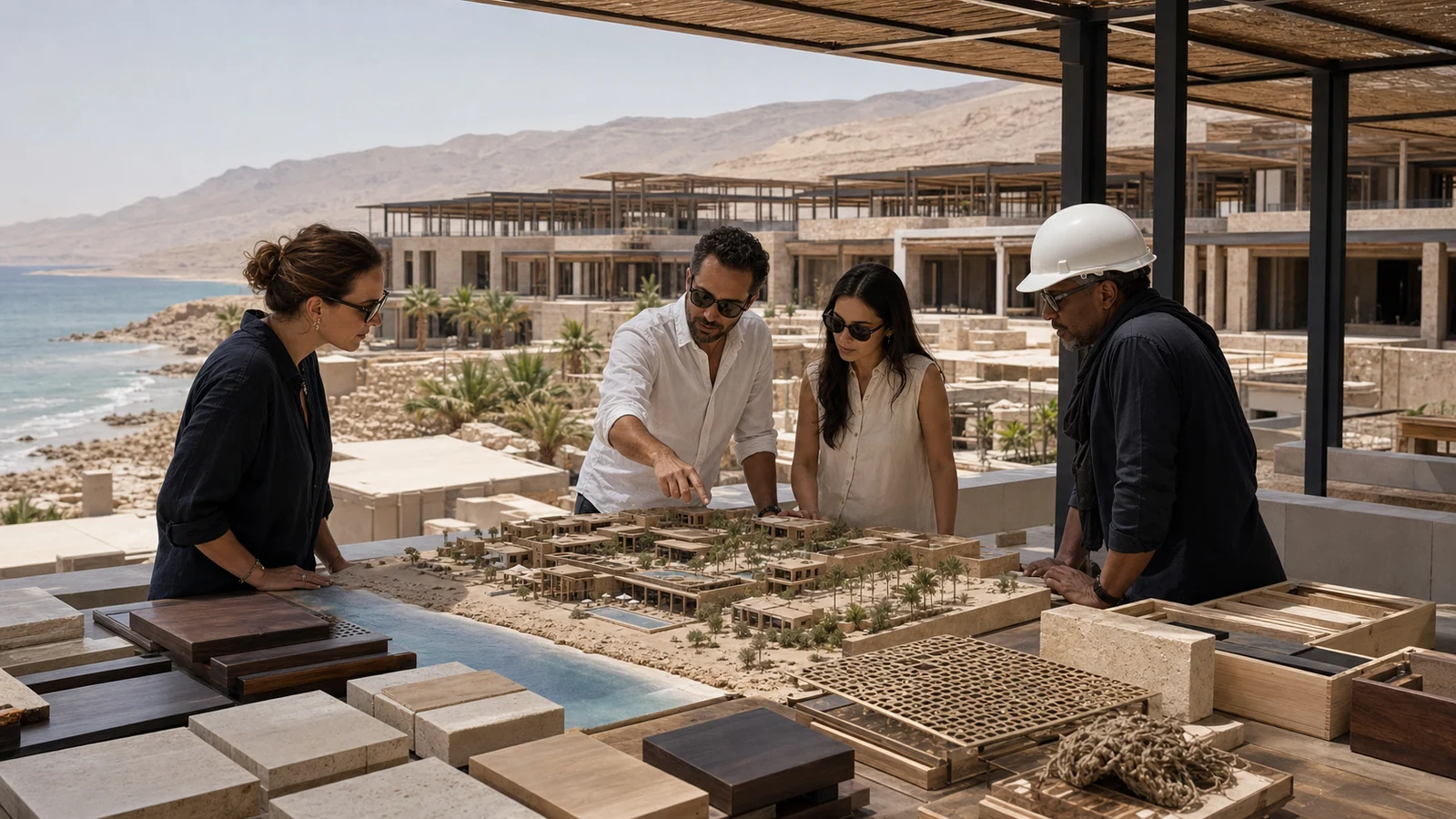
Villa and Hotel Projects Abroad: A Guide to the International Process and Coordination
A villa or hotel project abroad demands that local regulation, procurement and remote coordination be managed from a single hand. We explain how to run it with the right sequence, a transparent budget and a line-by-line quotation, drawing on examples from the field.
The real difficulty of building a villa or hotel abroad is hidden not in the drawing but in the coordination. When local regulation, material procurement and remote management are set up in the right order, distance ceases to be a problem; when they are not, even the smallest detail can cost months and serious money. At the heart of the matter lies a single thing: bringing design, implementation and construction together under one hand, one point of contact. A management team that achieves this keeps the client connected to the site even from a thousand kilometres away; one that does not turns into a chain of companies blaming each other for the delays.
Building a villa in Istanbul is not the same job as building one in Dubai, Tbilisi or on the coast of Montenegro. The materials look the same, the drawing software is the same, even the team may be the same. What changes is which document is obtained from which municipality, how many days a container of marble will sit in customs, and which detail the local craftsman will refuse with a 'we don't do it that way here.' It is not the technical side that is hard, but the coordination side.
In an overseas hotel or villa project managed from Turkey, risk accumulates in three places: distance, the difference in regulation, and how many hands responsibility is split across. The third is the most insidious. When one office does the design, a local consultant the permit, another contractor the construction and a fourth firm the interior, no one takes ownership when something goes wrong; everyone points to the one before them.
Every country's zoning logic speaks a language of its own. In some countries a plot has a building ban on the seafront, in others roof height is measured centimetre by centimetre, and in some regions a local legal entity is required for a foreigner to build on a property. Knowing these before starting the project is many times cheaper than learning them afterwards.
- Zoning and permit regime — How much of the plot, how many stories and which frontage carry building rights; from which authority and in what order the permit is obtained.
- Foreign ownership and legal structure — In some countries a building permit is issued only through a local company or partnership; this is a step that comes from law, not from the project.
- Building inspection and standards — Earthquake, fire, energy and mechanical standards vary by country; in Europe CE marking is decisive, in the Gulf local authority approval.
- Taxes and duties — Customs, VAT-equivalent taxes, municipal duties; if added to the budget later, they strain the project.
- Environmental and coastal restrictions — Shoreline, forest boundary, protected area; the item that causes the most delay and shows the least.
None of these items is a 'we'll sort it out later' matter. When the permit architecture of a project is framed wrongly from the start, the resulting cost difference is often several times the design fee. The correct sequence is set by drawing the local regulatory map before the drawing even begins.
In an overseas project the most expensive mistake is not the wrong material but the wrong sequence. Pouring concrete before the permit is a small error on paper but an irreversible one on site.
The character of a luxury project is hidden in its materials. The problem is this: the Italian marble, Turkish brass fittings or bespoke woven fabric you have chosen either do not exist in the country where the project is built, or arrive at three times the price, two months late. There are two roads here: either select everything locally and constrain the design, or procure the critical items centrally and manage the logistics.
Experienced management does not confuse the two; it deliberately blends them. The items that define the character — stone, bespoke lighting, the main cladding, kitchen and bathroom fittings — go through central, controlled procurement. The bulky and standard ones — structural material, some mechanical items — are bought locally. Getting this distinction right keeps both the budget and the schedule standing.
- Critical item list — Materials that define the look of the project and are unavailable locally are set apart from the start and ordered from a single source.
- Customs and delivery plan — The customs duration, tax and site-arrival date of every shipment are marked on the schedule; nothing is left to surprise.
- Local supply chain inspection — The sample of any material to be bought locally is compared against the approved specimen; 'similar' is not accepted.
- Backup supplier — Not relying on a single source for a critical item prevents one delay from halting the entire site.
The client is in Turkey, the site a thousand kilometres away. That distance is not closed by a weekly video call. The only thing that closes it is a disciplined, verifiable reporting routine. A photo-and-video stream showing what has been done on site, samples submitted for approval before fabrication, a progress and cash-flow table updated every week; without these, remote management turns into guesswork.
- 1On-site survey and regulatory map — The land, local zoning and procurement conditions are examined on site; the project is framed accordingly.
- 2Design and permit architecture — The concept is developed to comply with local regulation; the permit file is prepared in the right order.
- 3Room schedule and line-by-line quotation — Every room, every surface, every fitting is written out one by one; the quotation is given clearly on the basis of this list.
- 4Procurement and logistics plan — Items going from the center and from local sources are separated, and the customs and delivery schedule is drawn up.
- 5Site work and weekly reporting — Fabrication begins; a visual, documented progress report and expenditure table go to the client every week.
- 6Handover and warranty — At completion the snag list is closed, and warranty and maintenance terms are handed over in writing.
Working with four separate firms abroad means managing four separate time zones, four separate understandings of responsibility and four separate invoices. In a delay the designer blames the contractor, the contractor the supplier; the client is left in the middle. Having design, implementation and construction under one roof breaks this chain. There is one point of contact, one schedule, one person responsible for the budget.
Vesya's stance on overseas projects becomes clear here: the team that draws the concept and the team that runs the work on site are bound to the same table. That is why what a detail in the drawing will cost on site is known from the outset, and the client advances while seeing every step. No exaggerated promises; a transparent schedule, an open budget and verifiable progress.
The fixed square-meter price uttered at the first meeting of an overseas villa or hotel project is most often either incomplete or grows later. The healthy approach is this: first a realistic budget range is discussed for the project, then, once the room schedule is drawn up, it turns into a clear line-by-line quotation. Because the same 400-square-meter villa can vary up to twofold depending on the choice of stone, the facade system, the smart-home equipment and the target country's labour and customs structure.
In overseas projects managed from Turkey in 2026, the exchange rate, the customs regime and logistics costs directly affect the budget. That is why honest management does not quote a fixed price without tying the figure to the room schedule and the procurement plan. It gives a range, draws up the list, then speaks clearly.
- Budget range — A realistic upper-lower band is shared from the start, according to the scale of the project and the target country.
- Room schedule — Once every space, surface and fitting is put in writing, the quotation becomes clear line by line.
- Currency and logistics allowance — Foreign-exchange and customs movements appear as a separate item in the budget; they are not hidden.
- Contingency fund — A small margin of flexibility in an overseas project absorbs a surprise before it turns into a crisis.
When starting an overseas villa or hotel project, the first question to ask is not price but sequence: who is drawing, who is building, who stands on site and who is the single point of contact? If these four questions are answered with a single name, distance ceases to be a problem.
In short
- In an overseas project the most expensive mistake is not the wrong material but the wrong sequence: the permit and regulatory map come before the drawing.
- Procure critical materials centrally under control, buy bulky standard items locally; compare every local material against an approved sample.
- Single-source management means one point of contact, one schedule, one budget; the more hands responsibility is split across, the more the risk rises.
- A fixed price is not stated at the start: a realistic budget range turns into a clear line-by-line quotation with the room schedule.
How we can help you on this
Journal
 Process
How to Choose the Right Architecture Firm: The Questions You Should Ask
How do you choose the right architecture firm? A practical guide built around references, itemized proposals and a single point of contact: the questions to ask in the first meeting, the contract clauses everyone misses, and the red flags that should stop you.
July 20267 min read Process
Villa Project Consultancy: What It Is, What It Covers, When You Need It
What is villa project consultancy, what does it cover and when do you need it? We explain, through an expert's eye, the difference made by single-point management — from feasibility to site supervision — and how the cost becomes clear.
July 20267 min read Process
Architecture & Interior Design Consultancy: When, Why, and to What Scope?
When, why and to what scope is architecture & interior design consultancy needed? We explain why, in hotel and villa investment, a question asked at the right moment is far cheaper than concrete poured on site.
July 20267 min readFrequently asked questions
Vesya Project Team
Design · Build · Construction
- Response time
- Same day
- Channels
- Phone · Email · WhatsApp
Can't find your answer here? Send us your question directly — our team will reply shortly.
Free consultationYes, it can; but not with good intentions, with a system. If a Turkey-based team draws the local regulatory map from the start, procures critical material centrally, puts local supply through inspection and shares a visual, documented progress report and expenditure table every week, distance ceases to be a problem. What is decisive is bringing design, implementation and construction together under a single point of contact. The more hands responsibility is split across, the more the risk rises.
Vesya Project Team
The most expensive surprises arise in local regulation and during procurement. Framing the permit in the wrong order, skipping the legal structure required for foreign ownership, noticing a coastal or protected-area restriction too late, and critical material stuck in customs are the four most common causes of delay. All of these can be prevented by a survey and regulatory study carried out on site before the drawing begins.
Vesya Project Team
The two are often confused. The items that define the character of the project — bespoke stone, the main cladding, lighting, kitchen and bathroom fittings — go through central, controlled procurement. Bulky materials such as structural work and standard mechanical items are bought locally. Every material bought locally is compared against an approved sample; 'similar' is not accepted. This distinction keeps both the budget and the schedule standing.
Vesya Project Team
It would not be right to state a fixed square-meter price at the very start. The healthy way is to discuss a realistic budget range according to the scale of the project and the target country, then turn it into a clear line-by-line quotation once the room schedule is drawn up. A villa of the same size can vary up to twofold depending on material choice, facade system, equipment and the country's labour and customs structure. The currency and logistics allowance is shown as a separate item in the budget.
Vesya Project Team
Yes, and you see the difference most in moments of crisis. When four separate firms are involved, in a delay everyone blames the one before them and the client is left in the middle. When design, implementation and construction are under one roof, there is one point of contact, one schedule and one person responsible for the budget. What a detail in the drawing will cost on site is known from the outset; this reduces both mistakes and surprises.
Vesya Project Team
The first step is not to ask the price but to set the right sequence. It begins with an on-site survey and a local regulatory map; then the design and permit architecture are framed, the room schedule and line-by-line quotation are prepared, and the procurement and logistics plan is drawn up. When construction begins, weekly documented reporting comes into play, and the work is handed over in writing with warranty terms. The four questions to ask at the start: who is drawing, who is building, who is on site, who is the single point of contact?
Vesya Project Team