
Hotel Room Design: Comfort, Acoustics, Lighting and Guest Experience
A good hotel room is defined not by decor but by four quiet decisions: comfort, acoustics, lighting and guest experience. The details that genuinely work, plus a 2026 cost approach.
Hotel room design is not decoration but the engineering of an experience: planning every moment from the first second the guest opens the door to morning check-out. Comfort is built with ergonomics, acoustics with invisible layers of insulation, lighting with light scenarios, and experience by never making the guest work for anything. When these four operate together, a room feels "good" — and most of the time the guest notices none of it, they simply relax.
Most of the answer is hidden in design decisions. Hotel room design is not a matter of decoration; it is the engineering of an experience that runs from the first second the guest opens the door to morning check-out. The tone of the door handle, the noise that does not seep in from the corridor, the reading lamp found by feel at midnight, a bench at just the right height to set your suitcase on... Each is planned separately. When it is planned well, the guest notices none of it; they only say, "I relaxed."
In this article we approach hotel room design along four axes: comfort, acoustics, lighting and experience. Rather than chasing trends, we will look at the details that genuinely work. Because a guest room is not tested on a moodboard but in the eyes of a tired guest who wakes at three in the morning.
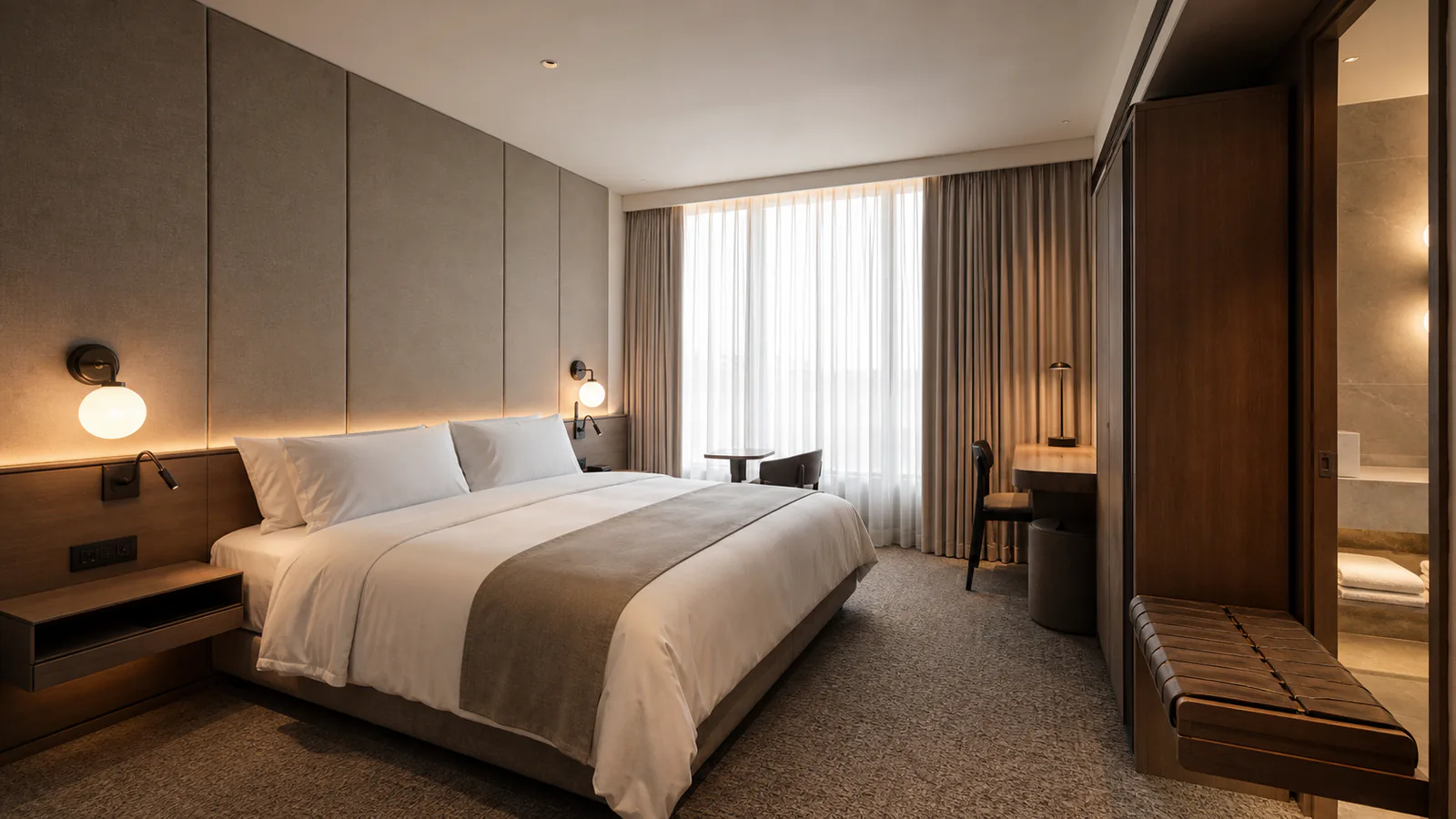
A comfortable room and an expensive room are not the same thing. Comfort is something measurable: the firmness balance of the bed, the nightstand sitting level with the mattress surface, the socket placed exactly where your arm reaches while lying in bed. The guest does not test these; they live them. And if one is wrong, it comes back as restlessness throughout the night.
In a standard guest room the most frequently overlooked points are well known: independently controlled lighting on both sides of the bed, a USB at the bedside for charging a phone, a real luggage bench where you can set your suitcase without bending over, a floor between the bathroom and the room that does not send you sliding on wet feet. These seemingly small items are what create the guest's sense that "this place was thought through."
- Bedside circuit — Each side of the bed should independently control its own lamp and its own curtain motor; having to switch on the ceiling light while your partner sleeps is bad design.
- Storage realism — A wardrobe built for a week-long stay differs from a shelf built for a two-night city break; it is solved by room type, not a single template.
- Reach heights — Socket, switch, hook and shelf heights are set according to seated and reclined positions; in accessible rooms this is not a preference but a requirement.
- Surface contact — The first places the hand touches (door handle, tap, cabinet pull) should be of warm, solid material; a plastic feel ruins the whole sense of luxury in a single touch.
The complaint that recurs most in hotel reviews is not price, it is noise. Conversation from the next room, a wheeled suitcase in the corridor, footsteps on the floor above, the hum of the air conditioning... Acoustics is the most technical and most neglected dimension of hotel room design. The reason is simple: it is invisible, and correcting it afterwards is both difficult and expensive.
The work really comes down to two headings. One is cutting the passage of sound between rooms, that is sound insulation; the other is managing the room's own internal echo, that is acoustic comfort. The first is solved through wall and floor construction, the second through materials and surfaces. An empty room with hard surfaces rings; a room where the carpet, curtain and textiles are in their proper place softens sound, and even makes speech more intelligible.
- Partition wall mass — Walls between rooms must have sufficient mass and insulation layers; the neighbour's television should not be heard, and this is decided at the design stage, not afterwards.
- Door and threshold — The one-centimetre gap under the room door is the main entry point for corridor sound; an automatic threshold seal and a filled door leaf cut it off.
- Plumbing noise — The flush, water and ventilation systems of adjacent rooms must be acoustically separated; a pipe running at night breaks the guest's sleep.
- Soft surface balance — Carpet, curtains and headboard textiles lower the room's echo; a fully hard room (marble, glass, concrete) looks elegant but is acoustically tiring.
A guest never praises good acoustics, because they do not notice them. Bad acoustics, on the other hand, are the first sentence of a one-star review.
The most common mistake is lighting a room with a single ceiling fixture on a single switch. Yet a guest room takes on at least four roles through the day: working, resting, getting ready, sleeping. Each role wants a different light. Good lighting design sets up these roles in advance and offers them to the guest with a single touch.
Color temperature is decisive here. Evening relaxation and sleep call for a warm, yellowish tone (around 2700K); for makeup or shaving in front of the bathroom mirror, a more neutral tone close to daylight works. Two different needs in the same room, two different solutions. In an automated room this transition comes down to a single scene button; the guest does not think about it, they find the right light ready.
- 1Welcome scene — When the door opens, a soft, warming general light comes on; the guest does not walk into a dark room feeling for a switch on the wall.
- 2Work scene — Focused, more neutral light at the desk and reading points that casts no shadows; enough for a laptop and documents, at a level that does not tire the eyes.
- 3Relaxation scene — The general light dims, indirect and warm light comes forward; the relaxing atmosphere of evening mode is established.
- 4Night scene — Low-level directional light under the bed or along the path to the bathroom; a guest who gets up at night does not have to switch on the ceiling lamp and wake fully.
In a hotel room, material is not chosen with home logic. A guest room sees hundreds of different guests a year; it must withstand cleaning chemicals, suitcase scratches, damp towels and spilled coffee. So the sense of luxury and operational durability must be solved at the same time. Surfaces that give the texture of natural wood and stone but resist wear and cleaning hold this balance.
Touch is again decisive. Everything that meets the guest's skin — bed linen, towels, headboard fabric, bathroom floor — determines perceived quality far more than the material's price tag. A surface that looks expensive but feels cheap is more damaging than one plain from the start; because it first creates expectation, then breaks it.
A good room guides the guest, it does not give them work. A tired person walking in should not have to think about where to put the suitcase, how to turn on the light, where to charge the phone. These should already be solved. The success of the design is measured by whether the guest can use the room intuitively, without looking for any instructions.
Trust is also built through design. The curtain fully closing off the street, the bathroom door truly giving privacy, the lock making a solid sound... These tell the guest's subconscious, "I am here and I am safe." Luxury often arises not from display but from the sum of these quiet reassurances.
The cost of hotel room design does not fit into a single per-square-meter price. Room type (standard, suite, villa module), star target, level of automation, material class and acoustic requirements determine the total budget. Under 2026 Turkish conditions the difference between these items is considerable; that is why it is worth keeping a distance from the one-line "so much per square meter" claims found online.
The right path is this: first the concept and room program are clarified, then the room schedule is drawn up — which material on which surface, which fixture at which point, how many lighting circuits, which acoustic detail. A real and comparable quote can only arise from this item-by-item list. In projects where Vesya runs the design → application → construction process under one roof, this transparency is established at the very first table; the surprise interim costs that emerge later are cut off from the start. In short, a range is discussed, the exact figure is read from the room schedule.
What really makes a room expensive is not the price of the material, but a wrong decision later being torn out and redone.
Comfort is built with ergonomics, acoustics with invisible layers, lighting with scenarios, and experience by never making the guest work. A room begins to feel "good" not when these four are each good on their own, but when they work together. This is exactly why it matters that the same team carries the work from design through to construction: a detail that looks lovely in the drawing means nothing if it is not built correctly on site.
In short
- Comfort is something measurable: independent bedside lighting, correct socket heights and a real luggage bench come before decor.
- Acoustics is the room's invisible layer; if wall mass, the door threshold and plumbing separation are not solved in the design, they cannot be corrected afterwards.
- Lighting is not a single light but welcome–work–relaxation–sleep scenarios; color temperature should change with the role.
- The exact price comes not from online per-square-meter claims but from the room schedule; a range is discussed, the firm quote is formed item by item.
How we can help you on this
Journal
 Hotel
HotelHotel Project Consultancy: An Investor's Guide from Feasibility to Opening
In hotel investment, the most expensive mistake is starting to pour concrete around the wrong concept. We explain what single-source, transparent hotel project consultancy from feasibility to opening delivers to the investor.
July 20267 min read Hotel
HotelBoutique Hotel Design: Concept Architecture That Creates Identity
Boutique hotel design is more than a beautiful interior; it is an identity, a story and an experience written into architecture. We explain the approach that turns a concept into a finished work.
July 20267 min read Hotel
HotelHotel Project Development: An Investor's Guide from Feasibility to Opening
What turns a plot of land into a full hotel is not architecture but decisions made in the right order. From feasibility to opening, every stage an investor needs to know.
July 20268 min readFrequently asked questions
Vesya Project Team
Design · Build · Construction
- Response time
- Same day
- Channels
- Phone · Email · WhatsApp
Can't find your answer here? Send us your question directly — our team will reply shortly.
Free consultationThe most overlooked detail is acoustics. The complaint that recurs most in hotel reviews is not price but noise: conversation from the next room, the sound of a suitcase in the corridor, the hum of plumbing. Because acoustics is invisible, it is noticed afterwards and correcting it is expensive. That is why the mass of walls between rooms, the door-bottom threshold seal and plumbing separation must be solved at the design stage, not after the work is finished.
Vesya Project Team
A guest room takes on at least four roles through the day: welcome, work, relaxation and sleep. Each wants a different light level and color temperature — a warm tone (around 2700K) for evening relaxation, a more neutral tone close to daylight for makeup in front of the bathroom mirror. Good design sets up these scenarios in advance and offers them to the guest with a single touch; a single-switch ceiling fixture is inadequate.
Vesya Project Team
Giving a single per-square-meter price would be misleading; cost varies considerably by room type, star target, level of automation, material class and acoustic requirements. The right method is first to clarify the concept and room program, then to draw up the room schedule — which material on which surface, which fixture, how many lighting circuits. A real and comparable quote can only be formed from this item-by-item list.
Vesya Project Team
Hotel room material is not chosen with the same logic as a home. It sees hundreds of guests a year; it must withstand cleaning chemicals, suitcase scratches, damp and wear. That is why surfaces that give the texture of natural wood and stone but are operationally durable are preferred. Everything that meets the guest's skin — bed linen, towels, headboard fabric, bathroom floor — determines perceived quality more than the price of the material.
Vesya Project Team
In a small room, comfort comes not from enlarging the square meters but from getting every centimetre right: a bench where you can set the suitcase without bending, independent lighting and a USB at the bedside, storage genuinely suited to the room type, and textiles that balance the echo of hard surfaces. If reach heights are set according to seated and reclined positions, even a small room can feel more comfortable than a large one.
Vesya Project Team
Running design, application and construction from a single source ensures that decisions made in the drawing are not lost on site. An acoustic or lighting detail that looks good in the drawing, if it falls into the coordination gap between different teams, is built wrong and is torn out and redone — and that is the most expensive cost. In work run from a single source, transparency is established at the outset and surprise interim costs are cut off from the start.
Vesya Project Team